
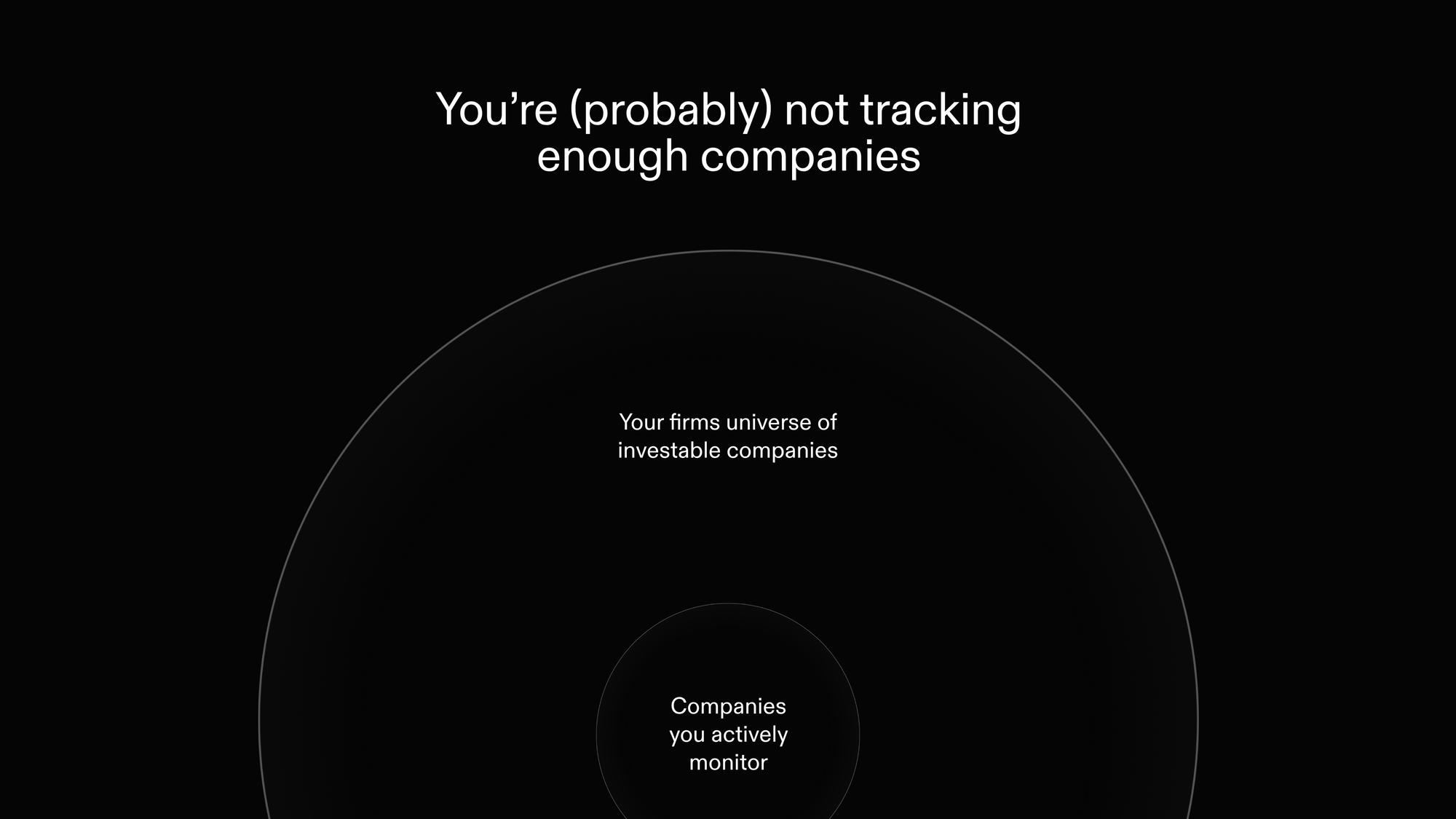
How many companies are sitting in your CRM right now that you haven't looked at in six months?
If you're like the majority of firms we speak with, the answer is: almost all of them.
Amy helps investment teams monitor an order of magnitude more companies from their investable universe.
Want to learn more?
The CRM Graveyard Problem
Most firms suffer from the same challenge, and it goes something like this:
You see a company you like, but you "pass-for-now".
Maybe it's a bit too early, you need some more traction, key team members missing, or any other reason.
The company gets added to a nurture/track/watchlist/monitor column in your CRM.
This column grows, and grows, and grows, to the point where it becomes impossible for the human investment team to effectively monitor the progress of these companies.
9 months later, you read a headline that the company has been killing it and closed new funding.
The team kicks themselves; "this was in our pipeline, we should have reached back out!"
Rinse & Repeat.
We call this the CRM graveyard problem.
The four buckets of companies you should be tracking
Most firms think about company tracking in terms of portfolio companies. That's the bare minimum.
The firms that gain a competitive advantage will monitor companies across four categories:
Portfolio Companies - Your existing investments. You're probably tracking these well because you have to: board seats, quarterly updates, follow-on decisions. Table stakes.
Prospective Pipeline - Companies you've met, didn't invest, but want to monitor. This is where tracking breaks down. You liked them, but timing wasn't right or price was too high. Now they're buried in "Nurture" and nobody's actually nurturing.
Portfolio Competitors - The companies competing with your portcos. You should know when a competitor raises, hires aggressively, or launches something new. Most firms only hear about this when their portfolio CEO mentions it on a board call. Too late to be useful.
Anti-Portfolio - The companies you passed on. Almost no firm tracks these systematically, which is wild given how much you can learn. Understanding how your passes performed helps you spot blind spots and sharpen your judgment.
Most firms track category one well, category two inconsistently, category three barely, and category four not at all.
What this costs your team
Companies change. The startup you passed on 18 months ago might have figured out their unit economics. The founder you thought was too green has shipped three major releases. The market you thought was too small just had a regulatory shift.
If you're not tracking, you don't know. By the time you find out through a funding announcement, someone else has led the round.
When a portco competitor raises quietly and starts hiring aggressively, you want to know before your board meeting, not during it. You can't give good strategic advice if you're learning about market shifts at the same time as your founders.
When you track your passes systematically, you start seeing patterns in your mistakes, valuation concerns that proved unfounded, market skepticism that missed the point. Without tracking, those lessons get lost and you make the same mistakes again.
The problem isn't effort. Partners manage a dozen portfolio companies while juggling hundreds of pipeline relationships, board meetings, sourcing, and founder support.
Manually tracking a thousand companies across all four buckets doesn't work. Spreadsheets don't scale. "I'll remember to check in" doesn't hold up. Your CRM captures data at a point in time, then sits there while reality moves on.
This is a capacity problem, not a commitment problem.
See everything. Miss nothing.
This is why we built Amy, so your team never has to say "we should have reached back out" again.
Amy autonomously monitors every company that matters to your firm.
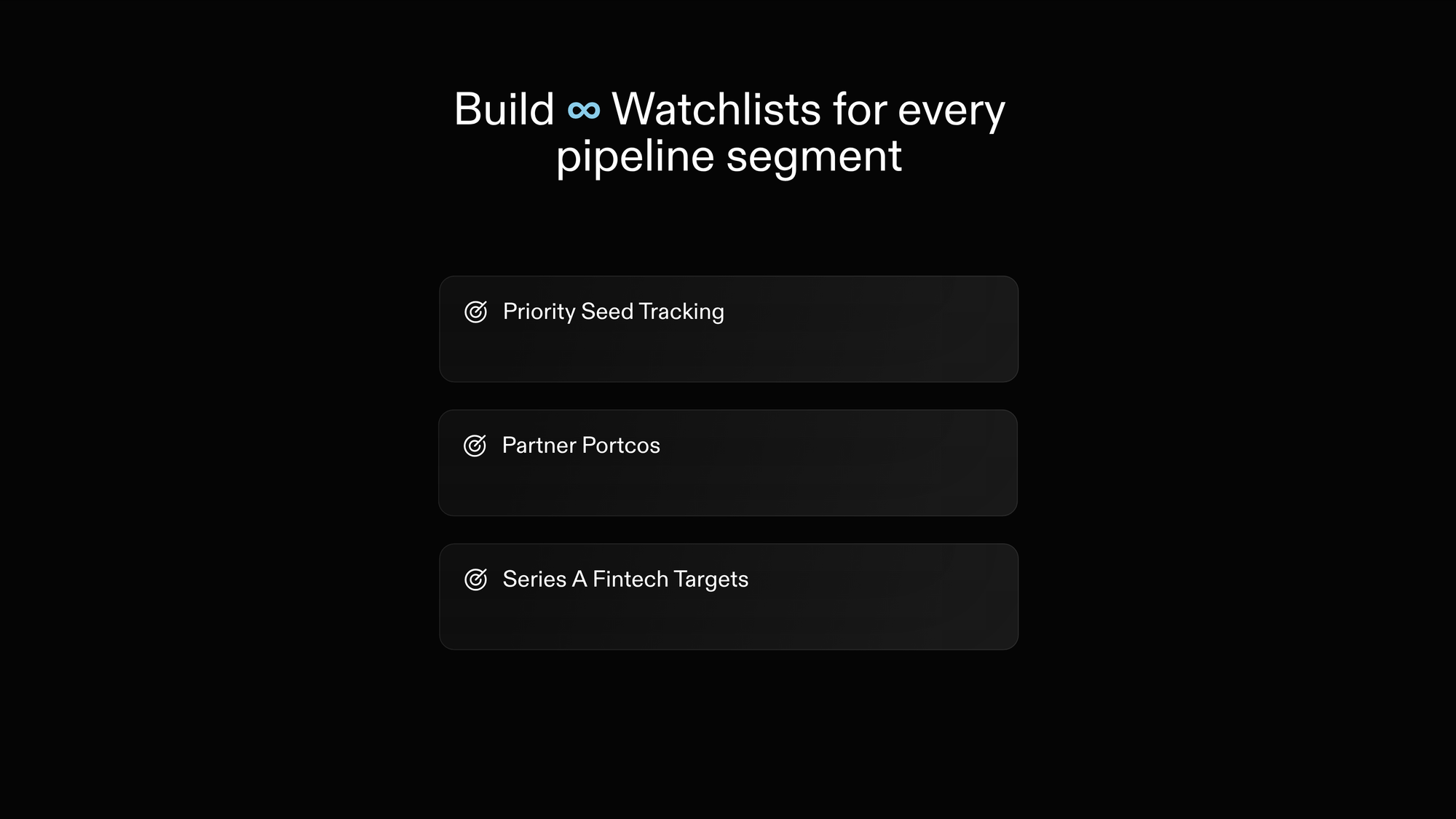
Build watchlists that represent any segment of your team's deal pipeline; prospective Series B targets, portco competitors, companies you passed on last year - and tell Amy the signals that matter most for each one. This is where the alpha is: not just tracking companies, but defining exactly what changes you want to know about.
Every two weeks, Amy collects data on every company across your watchlists, runs sophisticated change detection, and reports back on key findings.
When a pipeline company adds 16 people in a month — 11 in enterprise sales — Amy doesn't just flag headcount growth. It tells you they're pushing upmarket, connects it to their new pricing tier, and flags relevance to your portfolio.
The result?
Your team can monitor an order of magnitude more companies, without adding headcount.
If the CRM graveyard problem sounds familiar, and you're ready to do something about it, we should talk.